Pages

For most for us Indians, the perfect and comforting food during cold weathers or rainy season is a very popular and comforting Indian snack, Pakoda or Pakodi. Best enjoyed over a hot cup of tea, the cripsy and spicy Pakodi makes tea time something special, almost like a bonding time between family and friends.
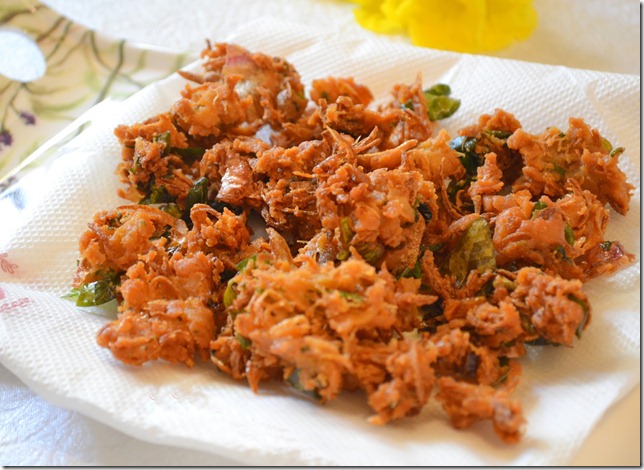
onion pakoda

Ingredients:

  • 1 1/2 cups besan (gram dal flour)
  • ½ cup rice flour
  • 4-5 green chillis, finely chopped
  • 2 large onions, sliced
  • 2 spring onions (optional)
  • 2 tbsp melted ghee (clarified butter)
  • few sprigs curry leaves
  • salt to taste
  • pinch of baking soda
  • oil for deep frying

Method

  • Combine both the flours with salt, soda, green chillis, curry leaves and onions. Add the melted ghee and mix well with fingers. Combine well till u have a crumbly texture.
ulli_pakodi_batter

  • Add few tablespoons of water and mix well that it forms a hard batter. Don’t add too much water.

  • Heat enough oil in a deep frying pan. It should be piping hot. Use your fingers to drop the batter in the oil to form small fritters. Reduce heat to medium and deep fry till they turn golden brown. Use a ladle to keep turning the fritters so that it cooks on all sides.

  • Once they turn golden brown, remove them on to absorbent paper. Store in air tight containers and serve as evening snacks over a hot cup of masala chai (spiced tea).
Read more ...

rasmalai 

Ingredients

  • Powder milk 1 cup
  • All purpose flour 1 tbsp leveled
  • Egg 1
  • Baking powder 1 tsp
  • Clarified butter 1 tbsp
  • For Rabri:
  • Fresh milk 1 kg
  • Sugar 5 tbsp
  • White cardamoms 2 – 3
  • Pistachios 1 tbsp (sliced)

Method

  1. Mix egg, baking powder, and butter all together and form into a dough.
  2. Rub it very well.
  3. Make 12 balls and slightly flatten it.
For Rabri:
  1. Boil milk, sugar, white cardamoms and pistachios till it gets slightly thick.
  2. Then add your rasmalai to it.
  3. Cover and simmer on low flame for about 5 – 8 minutes or until they swell.
  4. Then remove, cool and transfer into a serving platter.
Chill and serve.
Read more ...
pumpkin-halwa
Ingredients
  • Red pumpkin (bhopla/kaddu),peeled and grated 800 grams
  • Ghee 2 tablespoons
  • Sugar 100 grams
  • Khoya/mawa,grated 70 grams
  • Cashewnuts 10-12
  • Raisins 10
  • Pistachios 8-10
  • Green cardamom powder 1 teaspoon

Method

  • Heat the ghee in a non-stick kadai. Add the pumpkin and sauté on low heat till soft. Add the sugar, mix well and cook till the sugar melts and the moisture evaporates.
    Add the khoya, cashewnuts, raisins and pistachios and mix well. Cook for five minutes, stirring continuously. Remove from heat and sprinkle green cardamom powder. Serve hot.
Read more ...


Punugulu / Bonda is a common street food in the coastal regions of Andhra Pradesh. Often served with peanut chutney or Toordal chutney called as Kandhi Pachadi. Some make them sour tasting using fermented batter, while some make them with fresh batter. There is no specific way to follow while preparing  batter, except that the batter must not be runny. Can be made with urad dal batter (idli/dosa batter) or whole moong batter. I always make these with fresh batter, since I do not prefer the sour tasting ones.  Whether to use the fermented batter or the fresh one is totally an individual’s choice and comfort.

Ingredients

  • Idli/Dosa Batter           1 cup
    Rava                         2 tbsps
    Rice flour                    4 tbsps
    Chopped onion             2 tbsps
    Chopped green chillies    1 tbsp
    Grated ginger               1/4 tsp
    Salt
    Coriander leaves
    Curry leaves
    Oil for frying

Method

  • Mix all ingredients well ( except oil). 
    Keep aside for 20 minutes.
    Heat oil in a kadai, drop small balls in the oil and deep fry them till golden brown.
Read more ...
gulab-jamun
Ingredients
  • Flour 2 tbsp
  • Dry milk powder 2 cups (preferably "Nido")
  • Oil 2 tbsp
  • Semolina(suji) 1 tsp
  • Eggs 3
  • Baking powder 2 tbsp
  • Sugar 2 cups
  • Water 2, 1/2 cups
  • Oil for frying
Method
  1. For Sugar Syrup: Take a pan, add water and sugar and bring to boil.
  2. Stir till sugar dissolves properly, leave it on low flame.
  3. For Gulab Jamun: Beat eggs and add flour, semolina, 2 tbsp oil, milk powder and baking powder, mix well and knead it for 5 minutes.
  4. Grease your palm with a little oil and make small balls of the mixture.
  5. Deep fry the balls, when they turned golden brown, strain out and add them in sugar syrup.
  6. Give two boils to this syrup and take out the gulab jamuns in a serving dish.
  7. Serve warm.
Read more ...


 rasgulla
Preparation Time: 30 mins.
Cooking Time: 40 mins.
Makes 16 rasgullas.

Ingredients For the rasgullas :
1 recipe chenna
1 tsp plain flour (maida) for dusting
For the sugar syrup:
5 cups sugar
1/2 cup milk
Other ingredients :
2 tsp plain flour (maida)
Method
For the rasgullas : Divide the chenna into 16 equals parts and roll each part into a ball, taking care to see that the there are no cracks on the surface
Dust the back of a flat plate (thali) lightly with the flour and place the rolled chenna balls on it.
For the sugar syrup :
Combine the sugar and milk with 3 cups of water in a large pan approx. 200 mm. (8″) in diameter and 150 mm. (6″) in height and heat while stirring continuously till the sugar dissolves.
When the syrup comes to a boil, the impurities in the sugar will begin to float on the surface, forming a grey layer.
Heat over a medium flame to allow the grey layer to float. Do not stir at this point as the layer will break and it will not clarify the syrup.
After about 5 minutes, slowly drizzle 1 cup of water form the sides of the pan with the help of a ladle. Water added at this stage will bring down the temperature of the sugar syrup and will not allow it to boil and break the grey layer.
Continue to simmer the syrup over a medium flame for about 10 minutes and then gently remove the grey layer using a slotted spoon.
Bring the syrup to the boil once again and then slowly drizzle another cup of water from the sides of the pan using a ladle. remove all the remaining impurities from the syrup, again using a slotted spoon.
Increase the flame and boil vigorously for 1 to 2 minutes. Keep aside.
How to proceed :
Mix 2 teaspoons of the plain flour with 3/4 cup of water to make a flour solution. Keep aside.
Heat the sugar syrup in a deep pan over a high flame and allow it to boil vigorously.
When it boils, sprinkle half the flour solution in the sugar syrup and then add the chenna balls by upturning the plate on which they are kept. (Do not touch the chenna balls at this point as they are fragile).
When the flour solution is added, a frothy layer is formed on the surface of the syrup.
If the frothy layer begins to subside, sprinkle the remaining half portion of the flour solution.
After this, keep on sprinkling water (minimum 1 cup) on the surface of the sugar syurp. Ensure that the syrup froths all the time while cooking the rasgullas.
Cook for about 15 minutes, continuously sprinkling water to enable the froth to form.
Check if the rasgullas are cooked. This is determined by touch. If the rasgulla springs back and retains its shape when pressed, it is cooked. Another way of checking is to drop a rasgulla in a pan of cold water.
If it sinks to the bottom, it is cooked.
Remove form the fire.
Transfer the rasgullas to a bowl along with 2 ladles of sugar syrup and 1 cup of water.
Cool and chill for approx. 3 to 4 hours before serving.
Tips:
Rasgullas should always be cooked on a very high flame.
While cooking rasgullas, the sugar syrup must froth continuously.
The pan should be approximately 200 mm. (8″) in diameter and 150 mm. (6″) in height and the sugar syrup should fill about 1/3 of the pan.
While making rasgulla shapes (see variation below), always ensure that there are no cracks on the surface of the shapes.
While cooking, rasgullas expand to at least 4 times their original size.
While sprinkling water on the syrup when the rasgullas are cooking,
make sure you sprinkle a little water at a time (approx. a teaspoon at a time using your hands) and not large quantities.
Read more ...